
The Schedule That Had to Fail
Why Judge Garnett set a schedule she knows won't hold.

When governments may unleash all their might in multiple prosecutions against an individual, exhausting themselves only when those who hold the reins of power are content with the result, it is “the poor and the weak,” and the unpopular and controversial, who suffer first — and there is nothing to stop them from being the last.
— Justice Gorsuch, dissenting, Gamble v. United States (2019)
A day has twenty-four hours. Produce a detained defendant for his state trial from federal custody and approximately fifteen disappear into transport, processing, proceedings, and return. Of the nine that remain, six are supposed to belong to sleep, though a recent article on detention and sleep disruption makes even that allocation sound optimistic. Around two or three hours remain. Whether that counts as meaningful participation in one’s own defense is just arithmetic.

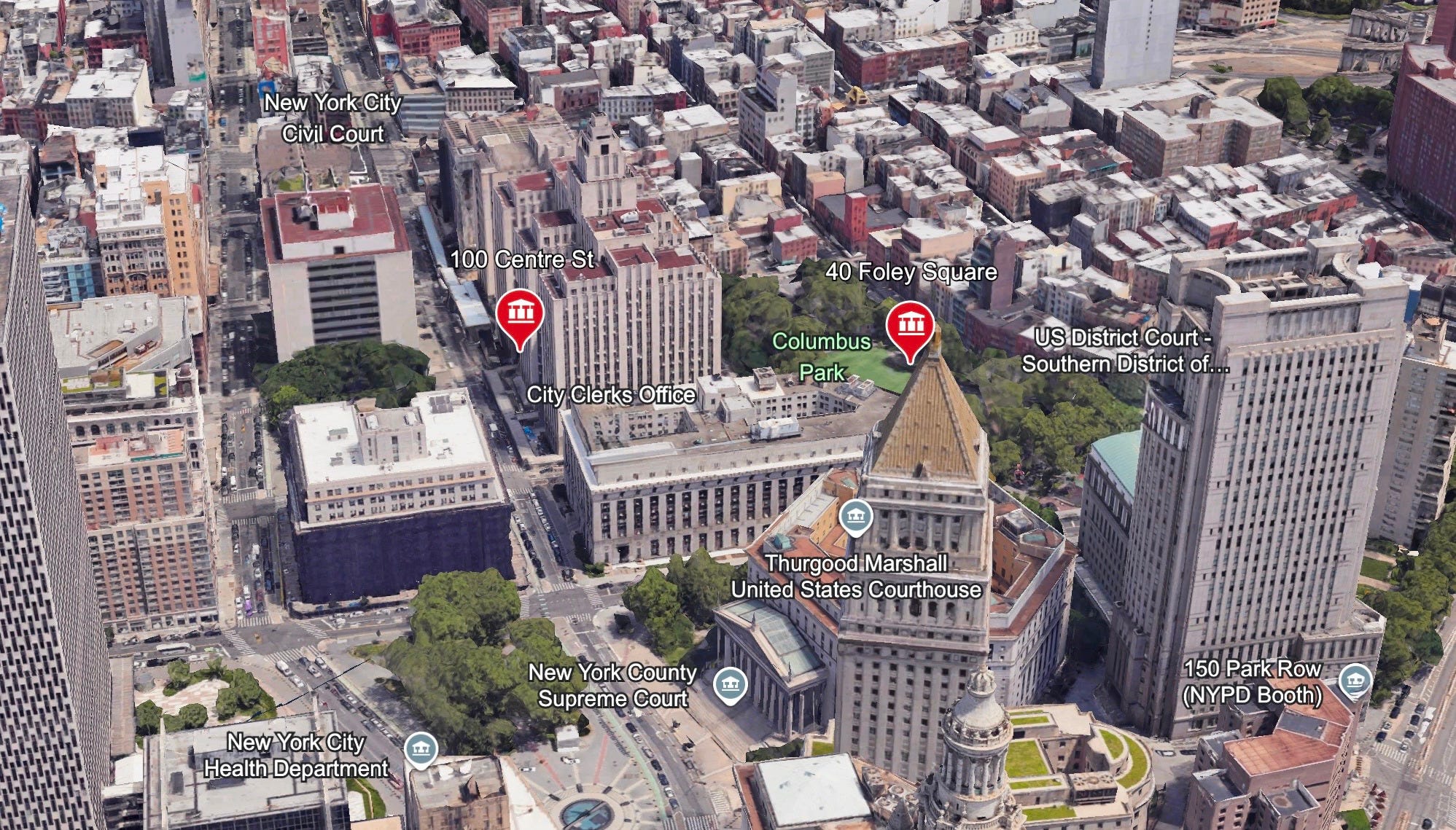
On April 1, 2026, a state judge adjourned a murder trial to September 8. On April 2, a federal judge set jury questionnaire administration for September 8 through 11. Same defendant. Same city. Same week. The dates are not coordinated because the courts are not required to coordinate. They are separate sovereigns, deriving power from different sources and permitted to act within the same territory on the same underlying event. Luigi Mangione is not two sovereigns. He is one person, in one facility, with one body that cannot be in two courthouses on the same morning.
At MDC Brooklyn, attorney access operates on the following schedule: Legal visits run Monday through Friday from 8:00 a.m. to 7:30 p.m., and weekends from 8:00 a.m. to 3:00 p.m. Institutional counts suspend movement, and attorneys arriving near count may have to wait until it clears. Legal calls must be booked at least 28 hours in advance through a separate scheduling platform. Depending on the housing unit, legal call time ranges from 2.5 to 5 hours per weekday, with no weekend availability through the platform. Protected electronic discovery is kept in a locked law-library locker and is accessible once per week for roughly 90 minutes. Here are the operating conditions under which every defense decision is made.
That is the infrastructure. It does not change when the calendar changes.
What changes is the schedule.
The Schedule
The state murder trial begins September 8. It is expected to last approximately six weeks, concluding somewhere in mid-to-late October. During that period, Luigi Mangione is produced daily from federal custody in Brooklyn to the Manhattan Criminal Courthouse and returned at day’s end. He leaves early. He returns late. Whatever the precise transport mechanics, the point is the same: the court day consumes the day.
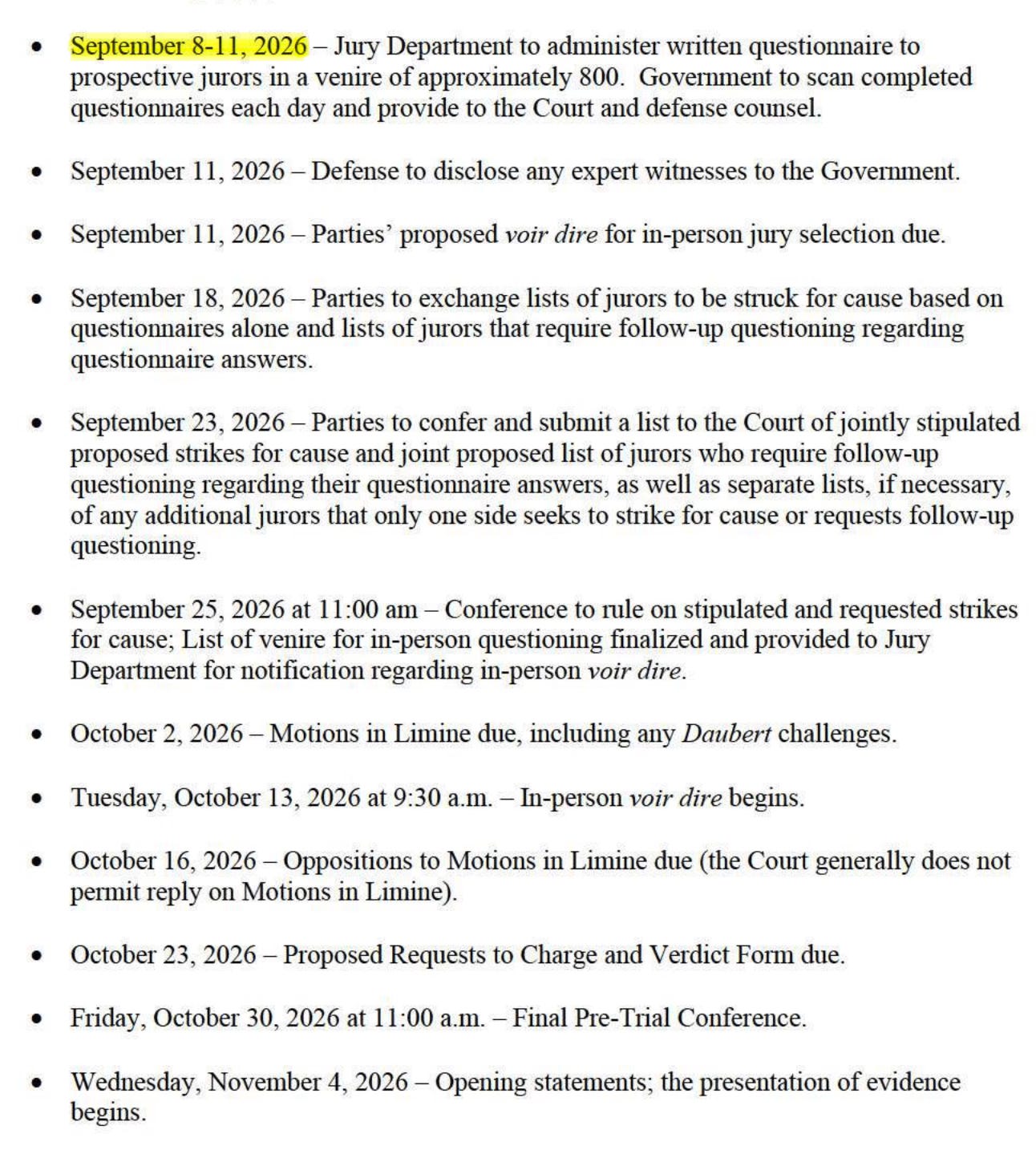
The new federal scheduling order sets the following deadlines during the same period:
The Numbers
Most of these deadlines demand the defendant’s participation. 800 questionnaires is not some mundane work. Each questionnaire must be read, discussed with counsel, and used to identify who appears biased, who requires follow-up, and who should be challenged for cause. In other high-publicity federal cases, questionnaires have run into 28-30 pages and beyond. Even a very modest initial review time — 10 to 15 minutes per questionnaire — produces a burden of roughly 130 to 200 hours. That figure accounts for the initial reading only. It does not include the discussion, comparison, or preparation of strike lists that follow.
The questionnaires begin arriving September 8. The strike lists are due September 18. The defendant has ten days. During those ten days, he is simultaneously standing trial for murder in state court, being moved back and forth from federal detention, and returning each night to a facility where the laptop containing protected discovery is available only until 3:00 p.m. (hours during which he is not present). His legal calls require advance booking. His law-library access is weekly. An inmate-use laptop is stored in the visiting room and available only until 3:00 p.m. The arithmetic has not changed since the first paragraph.
Judge Garnett, who issued this schedule, is not unaware of the problem. At the April 1 hearing, she said that ensuring the defendant receives a fair trial was her paramount concern and that some things were beyond her control. It was also the federal court’s need to preserve a jury process in the wake of the publicity the state trial would generate. She used the phrase “dueling prosecutions.” She also ordered counsel to remain available for in-person voir dire beginning January 5, 2027, and for trial beginning January 25 through February 12, 2027, should further adjournment become necessary.
A judge who believed her own schedule would hold would not reserve a six-week window four months after the trial she just scheduled. She would not require an ex-parte status letter three weeks after the order. She would not specify that no further adjournment application will be entertained before that letter is received. This is a sequencing instruction. It defines when the next adjustment may be requested, not whether one will be.
This schedule is a procedural prerequisite for the plan that will replace it.
The Mechanism
Judge Garnett is operating inside a set of constraints worth laying out, because they explain why a schedule that appears unworkable was issued by someone who appears to know it is unworkable. They also reveal something about a system that can produce this outcome and call it functioning.
A federal judge does not simply clear her calendar based on what she thinks a state court might do. She can respond to what a state court has done — a filed order, a confirmed trial date, a documented conflict — but she cannot preemptively clear her calendar based on a prediction. This is what happened on April 1. If she had adjourned the federal trial on the theory that the state trial will make participation impossible in September, the adjournment rests on speculation. The prosecution can object. On what documented basis did the court vacate six months of scheduled proceedings? Because the judge guessed? Judicial decisions require a record.
There is a second constraint that is structural. Under principles of federalism and the structural independence that the dual sovereignty doctrine assumes, a federal court and a state court operate as independent authorities. If the federal judge formally moves her trial because a state judge moved his, she has established that the state controls the federal calendar. That is a concession of sovereignty, something the doctrine's logic does not permit, regardless of how practically obvious the conflict may be. Judge Garnett must issue her schedule as if the state trial is one factor among several. The order must read as independent case management. It cannot read as deference.
This produces a specific procedural sequence. The judge issues a schedule she has reason to believe will not survive contact with the state trial. The schedule runs. If the collision occurs (and the arithmetic suggests it must), the collision is documented — through the ex parte status letter the judge has already required, through motions if necessary, through the visible impossibility of a defendant standing trial in one courthouse while his federal deadlines expire in another.
At that point, the adjournment is supported by the record. It is a response to demonstrated necessity, not some prediction or a deference to a state court. The documented failure of the current schedule becomes the factual foundation for the next one.
The ex parte status letter — due April 24, three weeks after the order — is the mechanism that makes this sequence functional. Judge Garnett cannot call Judge Carro and ask what’s happening with his calendar. She cannot send a clerk to inquire. The system provides no formal channel between two sovereign courts managing the same defendant.
So one was created: a letter from defense counsel, containing information about the state proceedings that the federal court has no other authorized means of obtaining. It is a private communication, not a public filing in the ordinary sense. The adjustment, when it comes, appears to originate from new case-specific information rather than from subordination to another sovereign’s calendar.
Everyone involved knows this schedule will fail. No one involved has the authority to act on that yet. What’s in between those two facts is the system operating as designed.
The system treats the two cases as independent. The jury pools are different. The judges are different. The charges are different. The defendant is not. He is one person, in one cell, with one mind that does not subdivide on command.
The state court manages the state case. The federal court manages the federal case. No one manages the defendant.
Thank you for this detailed explanation! Makes much more sense now why what happened, happened, and how it will be adjusted.